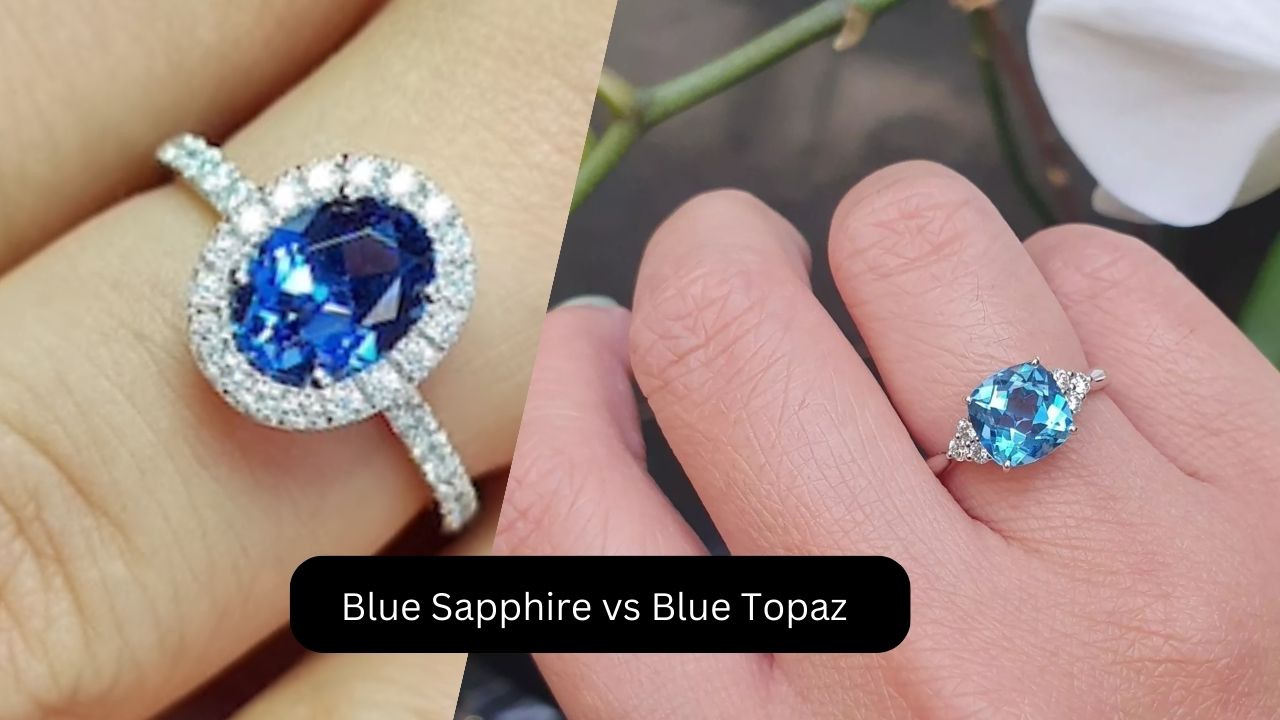
Two other gemstones with distinctive properties are blue sapphire and blue topaz.
A priceless stone from the corundum mineral family is the blue sapphire. It often has a blue hue and is renowned for being strong and resilient. Due to their strength and beauty, blue sapphires are often used in engagement rings and other jewellery. Blue sapphires are a common option for engagement rings since they are seen to be a sign of devotion and commitment.
On the other hand, owing to its similar colour to blue sapphire, blue topaz, a semi-precious gemstone, is often used as a replacement. Blue topaz comes in a variety of hues, from light blue to deep blue, and is often less costly than blue sapphire. Blue topaz is more vulnerable to dents and damage over time since it is not as strong or resilient as blue sapphire.
While having a similar colour, blue sapphire and blue topaz are distinct jewels with varying degrees of toughness and value. Blue topaz is a semi-precious stone that is less expensive but less durable than blue sapphire, a costly stone admired for its strength.
Let’s dive into the differences further:
| Blue Sapphire Gemstone | Blue Topaz Gemstone |
| Benefits: According to tradition, blue sapphire has a significant impact on both the wearer’s physical and mental health. It is intended to enhance mental clarity, boost focus and attention, and provide protection from negative energies and influences. In addition to promoting overall pleasure and prosperity, blue sapphire is thought to be helpful in lowering anxiety and depression. The blue sapphire enhances one’s communication abilities and recognises one’s brilliance and commitment, which leads to renown for the bearer. | Benefits: This vibrant blue diamond is referred to as the clarity stone. The significance of blue topaz enables you to access your inner knowledge and locate the ideal routes to prosperous chances. Anyone who wears this stone should accept their true selves, have faith in their abilities, and celebrate luck. People wear blue topaz around their necks because it is relaxing, assists with communication and self-expression, and is the colour of the throat chakra. |
| Ideal wearer: For those going through a trying time in their life known as “Shani Sade Sati” or “Dhaiya,” blue sapphire gemstones are advised. Sapphire is suitable for wear for those born under the astrological signs of Taurus, Gemini, Virgo, Libra, Capricorn, and Aquarius. With the owners of these zodiac signs, Saturn is amicable. Name, renown, prosperity, and wealth are bestowed to the bearer of blue sapphire. The person might aspire to get to a high position in society. | Ideal wearer: People’s self-expression and communication skills are enhanced by blue topaz. Therefore, it is advised for individuals who have trouble expressing their ideas clearly. People wear it around their necks because it is a very peaceful colour and represents the throat chakra. In addition, December is the home month of two of the most powerful astrological Zodiac Signs, Sagittarius and Capricorn. Blue topaz, the astrological gemstone for both of these signs, is also the birthstone for December. |
| Wearing rituals: Since it is connected with Lord Saturn, the Ceylon Blue Sapphire stone is thought to be the finest worn on the right hand’s middle finger. To cleanse and activate the gemstone, soak the ring in milk, honey, and filtered water for 20 to 30 minutes. Blue sapphires should be put in a silver or gold ring. Wear this stone on Saturdays between 5 and 6 a.m. (Shukla paksha). While chanting the mantra below, burn five incense sticks and circle them around the stone five times. “Om Shan Shanishcharay Namah” means “Om Shan Shanishcharay Namah.” | Wearing rituals: The blue topaz gemstone should be worn on Thursday from 4:24 to 6 a.m. or in the evening from 5 to 7 p.m. Blue Topaz gemstones should be worn on the middle or index finger of your right hand, touching the skin of your finger. Keep it in turmeric water for 24 hours prior. Purify it with Ganga Jal or cow’s milk before wearing it. When wearing it, chant the mantra ‘Om Sham Shanicharaya Namah’. |
| Hardness: The hardness of blue sapphire is comparable to that of diamond. It has a mineral hardness rating of 9 on the Mohs scale, indicating that it is exceptionally resistant to abrasion and wear. Because it can scratch other materials such as steel and glass, it is a popular option for industrial applications. So, consider blue sapphire to be the tough man of the gemstone world; it can withstand a lot of punishment while still shining brightly like a star. | Hardness: Blue topaz, on the other hand, has the hardness of a delicate blossom. It has a Mohs hardness rating of 8, indicating that it is still a moderately hard gemstone, although not as hard as blue sapphire. Blue topaz is prone to scratching and chipping, particularly if not properly cared for. So, consider blue topaz as the gemstone world’s sensitive soul; it must be treated with care and given a little extra TLC to continue looking its best. |
| Composition: Blue sapphire, is a member of the corundum mineral family. Corundum is an aluminium oxide mineral (Al2O3) that ranks second only to diamond on the Mohs scale with a value of 9. The presence of trace elements of iron and titanium in the crystal lattice structure gives blue sapphire its blue colour. Sapphires may be found in a variety of colours, including pink, yellow, green, and purple, among others. | Composition: Blue topaz, is a silicate mineral that belongs to the nesosilicate mineral group. Topaz is made up of aluminium, silicon, and oxygen, and its blue colour comes from trace components of iron and chromium. Topaz, unlike sapphire, is not as hard and has a lower Mohs hardness grade of 8. Topaz may also be found in a number of colours, including yellow, pink, and white. |
| Colour: The presence of trace amounts of iron and titanium in the crystal lattice structure causes it to be blue. Blue sapphire’s strength and saturation may vary based on the quantity and mix of these trace elements. Sapphires may be found in a variety of colours, including pink, yellow, green, and purple, in addition to blue. | Colour: Blue topaz, obtains its blue colour from the presence of iron and chromium trace components. It is important to note that not all blue topaz is natural; some may be generated by a method known as irradiation, which involves exposing colourless or pale topaz to high-energy radiation to change its colour. Natural blue topaz is uncommon and usually paler in colour than irradiated blue topaz. Topaz may be found in a variety of colours, including yellow, pink, and white, in addition to blue. |
Summary
Finally, there are significant distinctions between neelam stone price and blue topaz, including composition and the source of their blue colour. Blue sapphire is a harder corundum mineral with a blue colour derived from iron and titanium, while blue topaz is a silicate mineral with a blue colour derived from iron and chromium. Blue sapphire comes in a variety of colours, including pink, yellow, green, and purple, while blue topaz comes in yellow, pink, and white. It’s worth mentioning that genuine blue topaz is uncommon, and most blue topaz on the market has been chemically irradiated to produce its blue colour.
Also Check: – Who Can Wear Neelam Stone
