
In the realm of semi-precious blue color gemstones, none can match the allure, significance, and elegance of natural aquamarine stones and blue zircons. When it comes to semi-precious and natural blue gemstones, the entrancing light blue hues of aquamarine stone and the intense blue color of blue zircon can captivate anyone, and fulfill aesthetic appeal when embedded with the right jewelry type.
When choosing between two similar astrological gems, a lot of vital factors come into play. We know that an original aquamarine stone and natural blue zircon are alternatives to blue sapphire, share similar hues, and provide similar astrological benefits, but differ greatly in optical properties. So, how to pick the right gemstone between aquamarine and blue zircon? Don’t worry, we’ve got you covered! This blog post comprises the most comprehensive and technical Aquamarine vs Blue Zircon differences that will give you a broader perspective and enough data to decide which one to pick.
Aquamarine vs Blue Zircon: Origin
Aquamarine, a member of the beryl family (Be₃Al₂Si₆O₁₈), derives its name from the Latin aqua marina (“sea water”), a nod to its tranquil blue-to-greenish-blue tones. Its color arises from trace amounts of iron (Fe²⁺ or Fe³⁺) within its crystal structure. A raw Aquamarine stone forms in granitic pegmatites—coarse-grained igneous rocks—and hydrothermal veins, where mineral-rich fluids interact with host rocks under high temperatures and pressures.
These conditions are often linked to mountain-building events, such as continental collisions, which create the tectonic activity necessary for beryl crystallization. Major deposits are found in Brazil (notably Minas Gerais), Nigeria, Madagascar, Pakistan, and Mozambique. Brazilian aquamarines, often large and gem-quality, are sourced from pegmatites in regions like the Teófilo Otoni district. Pakistani specimens, from the Karakoram Range, are prized for their intense blue hues.
Blue Zircon (ZrSiO₄), part of the zirconium silicate mineral group, exhibits a broader spectrum of colors, with blue being the most sought after. Unlike aquamarine, zircon’s blue shade is typically not natural; most blue zircon is heat-treated brown or green material to enhance its color.
Natural blue zircon is rare and originates in igneous rocks (e.g., syenites, basalts) and metamorphic environments. Over time, zircon crystals may weather out of host rocks and accumulate in alluvial deposits, where they are mined. Key sources include Cambodia (the historic Pailin region), Sri Lanka, Tanzania, and Myanmar.
Cambodian zircon, often termed “Siamese zircon,” is renowned for its vivid sky-blue tones, while Sri Lankan stones, found in gravel beds, display a softer pastel blue.
Read Worthy: – Aquamarine vs Blue Topaz
Aquamarine vs Blue Zircon: Color Difference
Aquamarine: Aquamarine and blue zircon are both stunning gemstones celebrated for their captivating blue hues, yet they possess distinct differences in color that set them apart. Aquamarine, a member of the beryl family, is renowned for its serene, pale-to-medium blue tones, often reminiscent of the tranquil ocean. Its color typically ranges from a soft, almost translucent baby blue to a deeper, more saturated aqua shade, with undertones of green sometimes present, especially in higher-quality specimens.
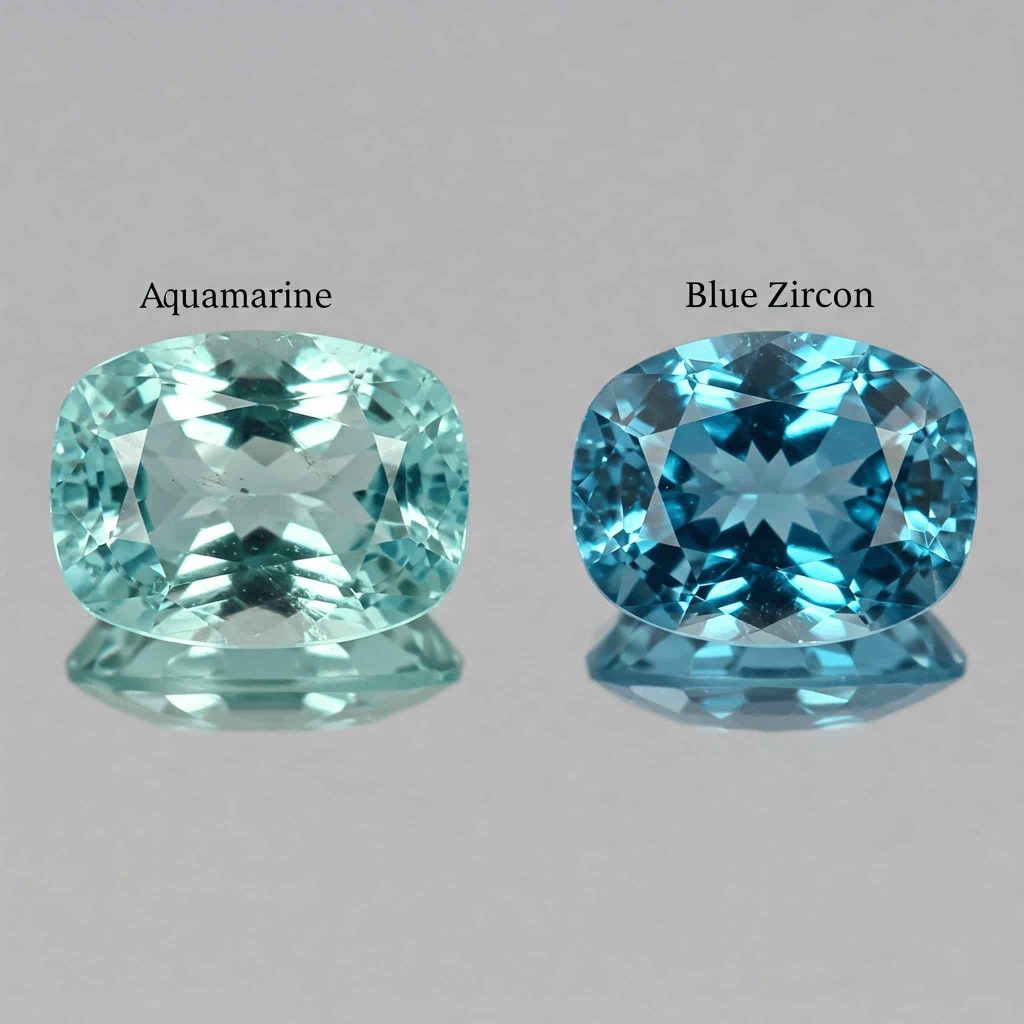
Blue Zircon: On the other hand, natural blue zircon exhibits a much more vibrant and intense blue, often drawing comparisons to the brilliance of a fine sapphire. Its hue tends to be richer and more saturated, with a striking clarity and fire that makes it stand out. While aquamarine’s subtle, soothing colors evoke a sense of calmness and elegance, blue zircon’s vivid sparkle offers a bold, eye-catching allure. The difference in their color intensity can largely be attributed to their unique mineral compositions and refractive properties, which influence how light interacts with each stone. Ultimately, choosing between aquamarine and blue zircon comes down to personal preference—whether you favor the understated grace of aquamarine or the dazzling vibrancy of blue zircon, both gemstones bring their own unique charm to jewelry designs.
Aquamarine vs Blue Zircon: Physical Properties
Aquamarine belongs to the beryl family, the same mineral group as emerald. It typically exhibits a pale blue to blue-green color derived from iron impurities in its crystal structure. With a hardness of 7.5-8 on the Mohs scale, aquamarine is quite durable for everyday wear, though it still requires reasonable care. Its crystal structure forms hexagonal prisms that often yield larger, cleaner crystals than many other gemstones, allowing cutters to fashion impressive large stones with excellent clarity.
Blue zircon, despite its similar name to synthetic cubic zirconia, is a natural gemstone composed of zirconium silicate. It displays a more intense, vibrant blue than typically seen in aquamarine, often with noticeable sparkling brilliance due to its high refractive index of 1.925-1.984, significantly higher than aquamarine’s 1.577-1.583. This property gives blue zircon exceptional fire and brilliance that can rival diamond. However, with a hardness of 6.5-7.5, blue zircon is somewhat softer than aquamarine and more prone to wear over time, particularly along facet edges.
The density of these gemstones also differs considerably. Blue zircon has a specific gravity of 4.6-4.7, making it notably heavier than aquamarine’s 2.66-2.80. This means that a blue zircon will feel heavier than an aquamarine of identical size, a characteristic that experienced jewelers can detect simply by holding the stones.
Regarding optical properties, aquamarine typically shows pleochroism—displaying different colors when viewed from different angles—with variations between lighter and deeper blues. Blue zircon exhibits stronger pleochroism between blue and colorless or grayish tones. Additionally, blue zircon is doubly refractive, causing a slight doubling effect of facet edges visible under magnification, a feature not present in aquamarine.
Don’t Miss: Aquamarine vs Amethyst
Aquamarine vs Blue Zircon: Treatment
Aquamrine: Aquamarine and blue zircon, both stunning gemstones, differ significantly in their treatments, which impact their appearance, durability, and value.
Aquamarine, a variety of beryl, is naturally pale blue to greenish-blue and is commonly heat-treated to enhance its color. This process, typically conducted at moderate temperatures around 400–450°C, removes yellowish or greenish tints, resulting in a more vibrant, pure blue hue that’s highly sought after.
The treatment is permanent, stable, and widely accepted in the gem trade, as it mimics natural geological processes without altering the stone’s structure. Some aquamarines may also undergo irradiation to deepen their color, though this is less common and requires disclosure due to potential residual radioactivity concerns.
Blue Zircon: Blue zircon, a naturally occurring silicate mineral, is almost always heat-treated to achieve its signature vivid blue shade. Untreated zircons are typically brownish or colorless, and heating at high temperatures (around 900–1000°C) in a controlled environment transforms them into the brilliant blue or blue-green hues seen in jewelry.
This treatment is also permanent and standard practice, but unlike aquamarine, zircon’s color can occasionally fade if exposed to prolonged sunlight or high heat, though this is rare. Additionally, zircon’s high refractive index and dispersion give it exceptional sparkle, but it’s more brittle than aquamarine, making it prone to chipping if mishandled during cutting or setting.
Both gemstones benefit from treatments that enhance their beauty, but aquamarine’s process is simpler and more consistent, while blue zircon’s transformation is more dramatic, requiring careful handling post-treatment to maintain its allure.
Also Read: – Surprising Aquamarine Stone Benefits
Aquamarine vs Blue Zircon: Astrological Benefits
Aquamarine and Blue Zircon are both beautiful blue gemstones often used in jewelry, but they possess distinct astrological benefits rooted in their mineral composition and planetary associations.
Aquamarine, with its serene hues reminiscent of the sea, is astrologically linked to the planet Saturn in Vedic astrology, although some Western astrologers associate it with Neptune or even the Moon and Venus. It is primarily known for its calming and soothing energies, believed to reduce stress, anxiety, and promote inner peace and emotional balance. Aquamarine is strongly associated with the throat chakra, enhancing communication skills, self-expression, and the ability to speak one’s truth with clarity and confidence. It is also thought to foster courage, improve decision-making, and bring harmony to relationships, particularly marital ones. Furthermore, some believe it aids in spiritual growth, intuition, and provides protection, especially during travel. Traditionally, it’s the birthstone for March and beneficial for Pisces, but can also benefit Taurus, Virgo, Gemini, and Aries depending on the specific astrological configurations.
Blue Zircon, on the other hand, is often associated with Venus and sometimes Jupiter in Vedic astrology. It is recognized for its brilliance and is believed to bring wealth, prosperity, and financial stability to the wearer. It is also considered a stone of love and harmony, promoting understanding, trust, and happiness in marital and other relationships. Blue Zircon is thought to calm a restless mind, reduce anxiety, and enhance mental clarity, focus, and creativity. It is also believed to have healing properties, potentially aiding with hormonal imbalances, skin conditions, and even emotional issues like depression. As a birthstone for December, it is often recommended for individuals born under signs like Libra, Gemini, Capricorn, Aquarius, and Virgo, depending on astrological interpretations.
Aquamarine vs Blue Zircon: Price Difference
Aquamarine: Aquamarine, a member of the beryl family, is generally more expensive than Blue Zircon. Its price can vary depending on clarity, color saturation, cut, and carat weight. High-quality aquamarine stones with deep blue tones and excellent clarity can range from ₹3,000 to ₹15,000 per carat or more in the Indian market. The rarity of deeply saturated blue aquamarine makes it more valuable, as most stones found are in lighter shades of blue or bluish-green. Aquamarine also enjoys strong popularity as a jewelry gemstone, further enhancing its market value.
Blue Zircon: Blue Zircon, on the other hand, is known for its vibrant color and exceptional brilliance, often resembling blue topaz or even blue diamonds in sparkle due to its high refractive index. Despite its beauty, Blue Zircon is significantly more affordable, typically priced between ₹500 to ₹3,000 per carat depending on its quality. While vivid, untreated stones command higher prices, Blue Zircon is generally more common and accessible than Aquamarine. However, its relatively softer nature (compared to aquamarine) affects its long-term durability, especially in rings, which can impact its pricing and desirability.
Check Out: – Blue sapphire vs Blue topaz
