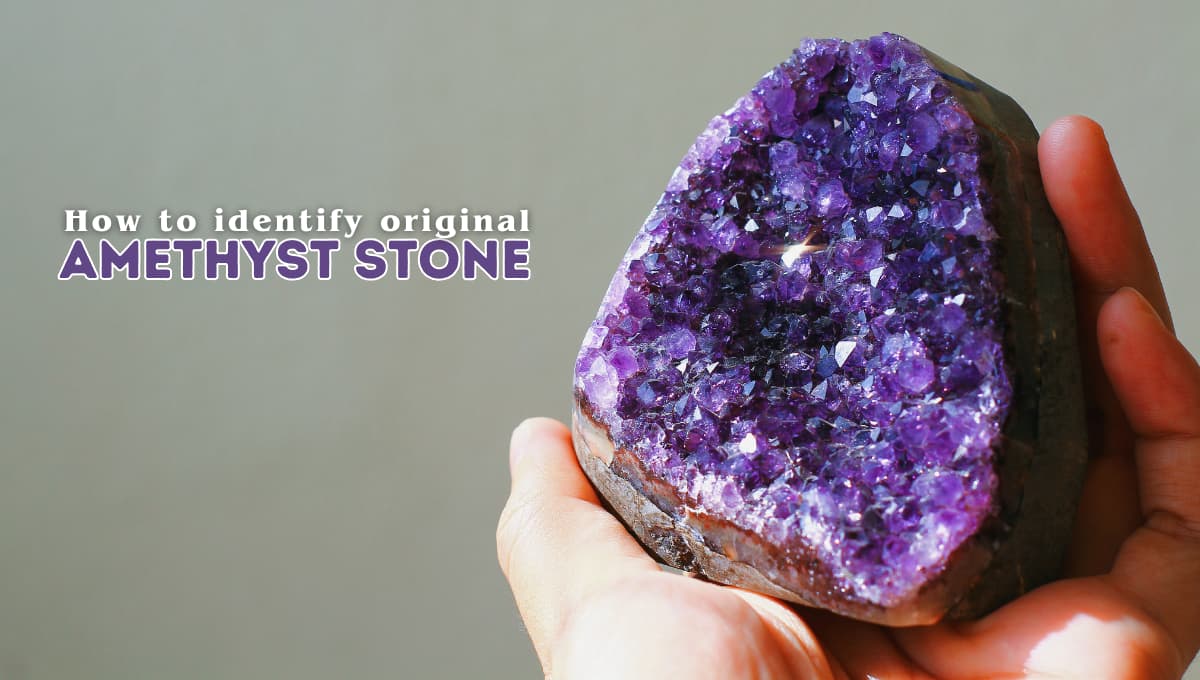
When the demand for a gemstone shoots up exponentially, market scammers find opportunities to sell the imitation of that rising gemstone to gullible people and rake big money. Like the Big 4 club of gemstones, amethyst is also one of the fabled and embraced gemstones in the realm of semi-precious gems. Amethyst, with its captivating purple hues, has enchanted jewelry lovers and crystal enthusiasts for centuries. Known as the stone of tranquility and spiritual growth, this stunning gem is a favorite in both adornments and healing practices. However, as its popularity soars, so does the proliferation of imitation stones flooding the market. For buyers and collectors, distinguishing a genuine amethyst from a cleverly crafted fake can feel like navigating a labyrinth of misinformation.
The stakes are high—whether you’re investing in a precious piece or seeking the stone’s reputed metaphysical benefits, authenticity matters. Fortunately, identifying an original amethyst doesn’t require a gemologist’s degree; it demands a keen eye, a bit of knowledge, and practical techniques anyone can master. From scrutinizing its color and clarity to testing its hardness and temperature, the secrets to spotting a true amethyst lie in its natural characteristics. In this blog post, we’ll unravel how to identify original amethyst stone and empower you to shop with confidence and connect with the real deal. Get ready to dive into the fascinating world of this violet treasure and learn how to separate the genuine from the counterfeit with ease!
Different Ways to Tell if Amethyst is Real
Color Check
Purpose: To assess the natural coloration and consistency of the amethyst.
How It Works:
Amethyst is a variety of quartz that typically exhibits a purple hue, ranging from light lavender to deep violet. The color is due to iron impurities and natural irradiation within the crystal lattice.
A genuine amethyst gemstone will often display subtle variations in color, with possible zoning (uneven distribution of color) due to its natural formation process.
Synthetic or dyed stones may appear unnaturally uniform in color or overly saturated, lacking the nuanced variations seen in natural stones.
Procedure:
Examine the stone under natural daylight or a strong light source.
Look for color zoning or gradients within the stone.
Compare the stone’s color to known samples of natural amethyst.
Indicators of Authenticity:
Natural amethysts often have slight imperfections or color variations.
Fake or treated stones may show artificial coloring, such as dye pooling along fractures or edges.
Bookmark Worthy: – Purple Sapphire vs Amethyst
Hardness Test
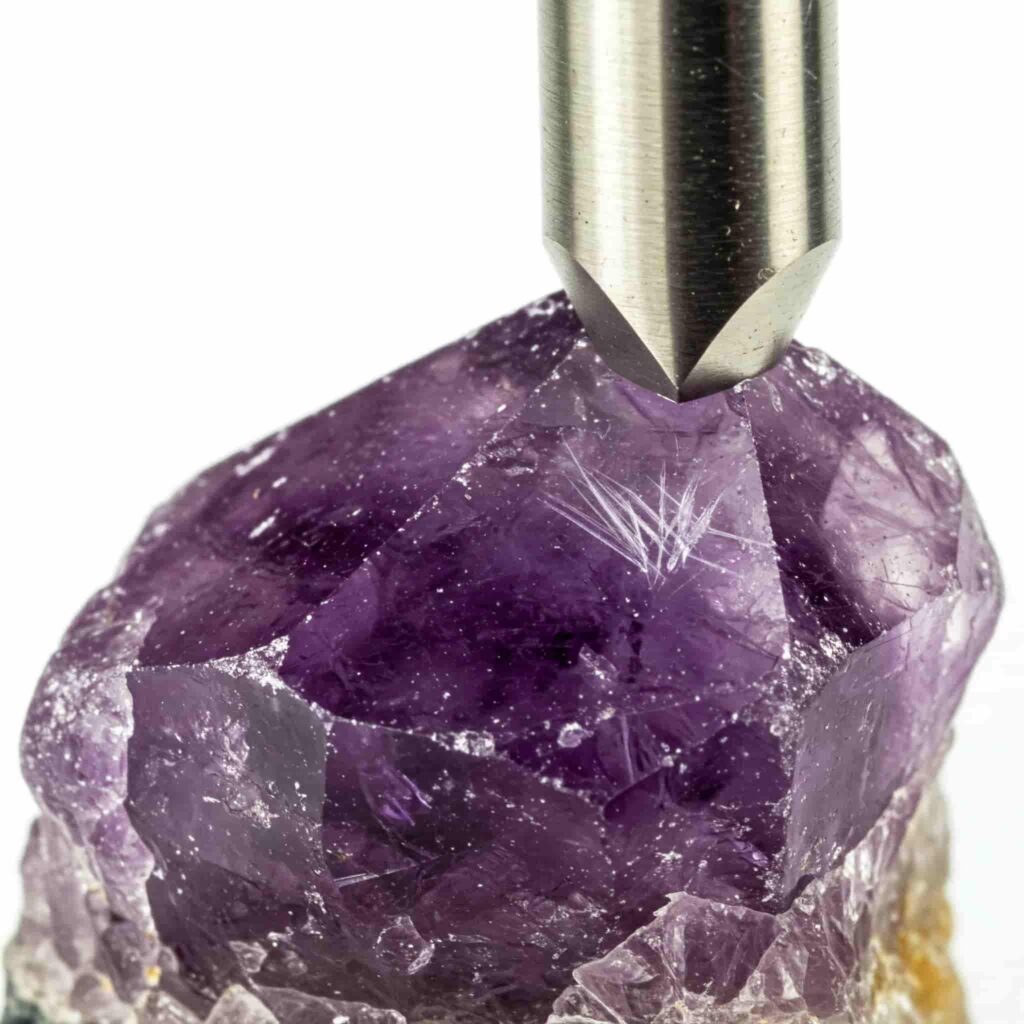
Purpose: To confirm the mineral hardness of the stone using the Mohs scale.
How It Works:
Amethyst is a variety of quartz, which has a hardness of 7 on the Mohs scale . This means it can scratch materials like glass (hardness ~5.5) but cannot be scratched by most metals.
Synthetic substitutes or imitations, such as glass or plastic, are usually softer and can be easily scratched.
Procedure:
Use a hardness testing kit or attempt to scratch the stone with objects of known hardness (e.g., a steel file or a piece of glass).
Observe whether the stone resists scratching or leaves a mark on the testing material.
Indicators of Authenticity:
If the stone scratches glass without being damaged itself, it is likely genuine amethyst.
If the stone gets scratched or damaged during the test, it is likely a softer imitation.
Read Worthy: – How To Wear Amethyst Stone
Specific Gravity Test
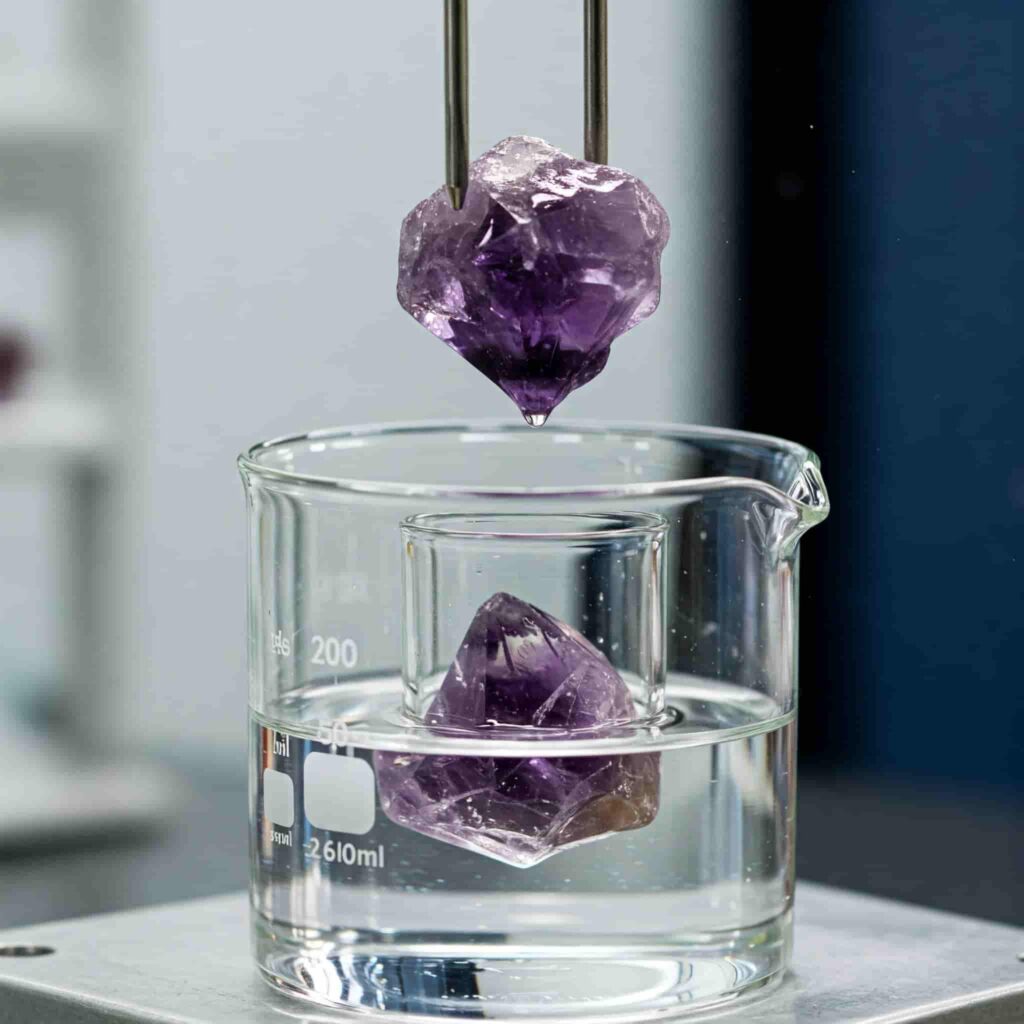
Purpose: To measure the density of the stone and compare it to the known specific gravity of amethyst.
How It Works:
The specific gravity (SG) of amethyst ranges between 2.65 and 2.66 , which is characteristic of quartz.
Synthetic materials or imitations (e.g., glass, plastic) often have different densities and will not match this range.
Procedure:
Weigh the stone in air using a precision scale.
Submerge the stone in water and weigh it again to calculate its displaced volume.
Indicators of Authenticity:
A result close to 2.65–2.66 confirms the stone is likely genuine amethyst.
Significant deviations from this range suggest the stone is a synthetic or imitation material.
Don’t Miss: – Benefits of Amethyst
Heat Resistance Test

Purpose: To evaluate the thermal properties of the stone and identify any artificial treatments.
How It Works:
Natural amethyst is highly heat-resistant due to its quartz composition. It can withstand high temperatures without significant damage.
Dyed or artificially treated stones may react differently when exposed to heat, showing discoloration, melting, or other signs of alteration.
Procedure:
Carefully apply a small amount of heat to the stone using a lighter or heated needle (avoid prolonged exposure to prevent cracking).
Observe any changes in color, texture, or structural integrity.
Indicators of Authenticity:
Genuine amethyst will remain stable and retain its color under moderate heat.
Dyed stones may lose their color or show signs of burning, indicating artificial treatment.
Glass or plastic imitations may melt or deform.
Clarity
Purpose: To identify natural inclusions and color patterns that distinguish genuine amethyst from synthetic or imitation stones.
Method:
Visual Inspection: Natural amethysts typically exhibit slight inclusions (e.g., tiny mineral crystals, fingerprints, or “tiger-stripe” color zoning). These imperfections are uneven and random.
Magnification: Use a jeweler’s loupe (10x magnification) or microscope to inspect internal features.
Authentic: Natural inclusions like jagged color banding, liquid-filled cavities, or hexagonal growth patterns (from quartz crystal structure).
Synthetic/Fake: Lab-grown amethysts may have fewer inclusions but can show “seed” particles or curved striations (unnatural for quartz). Glass/plastic imitations often lack inclusions entirely or display bubbles/flow lines.
Must Read: – Can I Wear Amethyst And Citrine Together
Check for Injected Dyes
Purpose: To detect artificial dyeing, which is rare in amethysts but occasionally used to enhance low-quality stones.
Method:
Color Distribution: Examine under bright light.
Authentic: Even, consistent purple hues with possible natural zoning (darker/lighter patches).
Dyed: Concentrated color in cracks/fissures, blotchy spots, or streaks.
UV Light Test: Shine ultraviolet light on the stone.
Dyed Stones: May fluoresce unnaturally (e.g., bright pink or orange).
Natural Amethyst: Typically inert or shows weak fluorescence.
Acetone Test: Dab a cotton swab soaked in acetone on the stone.
Dyed: Dye may leach onto the swab (especially in porous stones or fractures).
Authentic: No color transfer.
Price Analysis
Purpose: To assess if the amethyst stone price aligns with market rates for genuine amethyst.
Method:
Market Comparison: Compare the price to similar-sized, graded amethysts.
Authentic: Moderate pricing (amethyst is semi-precious; e.g.,
10–10–50 per carat for high-quality stones).
Too Cheap: Likely glass, plastic, or dyed quartz.
Too Expensive: May indicate misrepresentation (e.g., synthetic sold as rare natural stone).
Seller Reputation: Verify if the seller provides gemological certifications (e.g., GIA, AGS) for high-value stones.
Check Out: – Can I Wear Ruby & Amethyst Together
