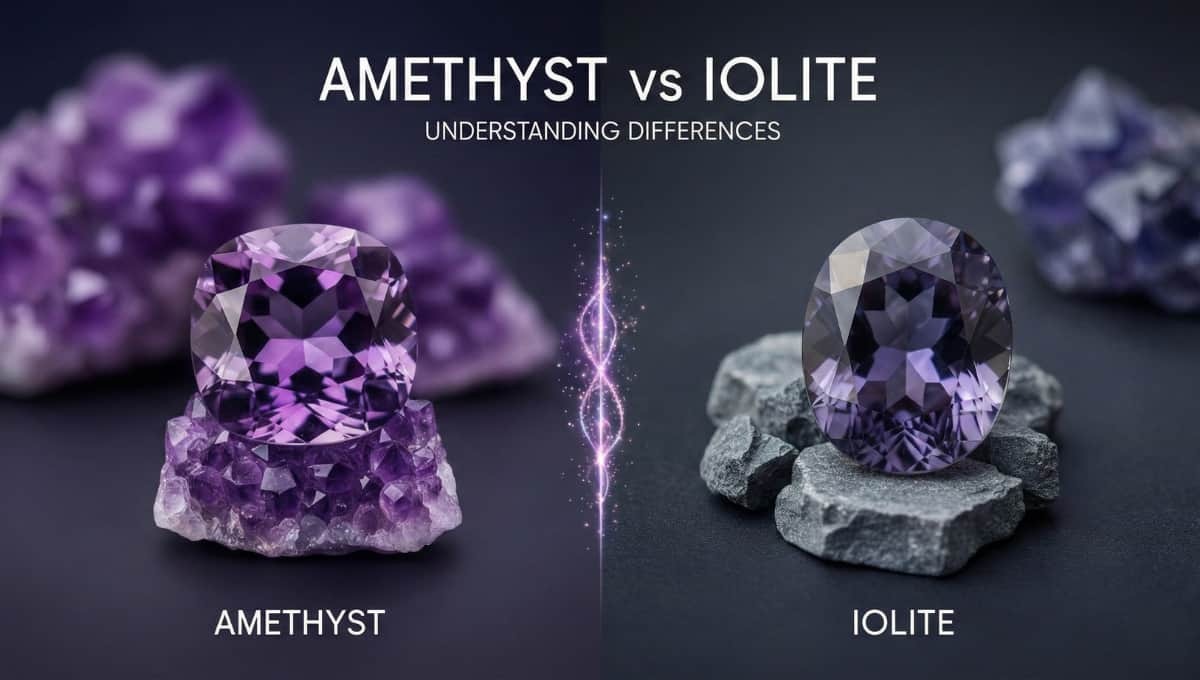
When it comes to choosing between purple gemstones, amethyst and iolite often create confusion among jewelry enthusiasts and crystal collectors alike. While both stones showcase stunning violet hues and offer similar durability for everyday wear, they possess distinct characteristics that set them apart. Amethyst displays primarily purple tones, while iolite always exhibits blue coloration, making color the most immediate identifier.
Amethyst, a quartz variety celebrated for centuries as a stone of spiritual clarity and emotional balance, forms in volcanic geodes through gamma irradiation and iron content. In contrast, iolite, nicknamed “Water Sapphire,” belongs to the cordierite mineral family and displays remarkable pleochroism—appearing to shift colors when viewed from different angles.
Whether you’re seeking the calming energies of amethyst for meditation or the intuitive guidance iolite provides for decision-making, understanding these gemstones’ unique properties, metaphysical benefits, and visual differences will help you select the perfect stone for your personal journey and jewelry collection.
Amethyst vs Iolite: Origin
When comparing Amethyst vs. Iolite, their captivating hues often spark curiosity among gem enthusiasts and jewelry lovers. Amethyst, the beloved February birthstone, dazzles in rich purple tones—ranging from pale lilac to deep violet, often with subtle red or blue undertones. Its color stems from iron impurities and natural irradiation, creating a regal, consistent appearance.
In contrast, Iolite—nicknamed “water sapphire”—exhibits dramatic pleochroism, meaning it displays multiple colors depending on the viewing angle. Typically seen in violet-blue to grayish-blue shades, Iolite can shift from light blue to deep indigo or even appear nearly colorless. This optical phenomenon makes Iolite uniquely dynamic but less uniformly purple than Amethyst.
While both gems share violet family ties, Amethyst stone offers steady, saturated purples, ideal for classic elegance. Iolite delivers a chameleon-like depth, favored for its mystical color shifts.
Amethyst vs Iolite: Origin
Amethyst is the most prized violet variety of quartz, one of the Earth’s most abundant minerals. It forms primarily in the geodes and cavities of volcanic rocks, where silica-rich water and trace amounts of iron slowly crystallize over millions of years. This process is often aided by natural radiation, which imparts the signature purple color. Major global deposits are found in South America, particularly Brazil and Uruguay (famous for their deep color), as well as Zambia and parts of North America.
In stark contrast, Iolite is a gem-quality specimen of the mineral cordierite (a magnesium iron aluminum silicate). It forms in silica and alumina-rich igneous rocks and is mainly found in metamorphic rocks like schists. Iolite is a rarer gemstone, with significant deposits located in India, Sri Lanka, Myanmar, Madagascar, and Brazil. Historically, the Vikings supposedly used Iolite’s strong pleochroism (the ability to show different colors from different angles) as a navigation tool, earning it the nickname “Viking’s Compass.”
Amethyst vs Iolite: Physical Properties
When comparing Amethyst and Iolite, both gemstones stand out for their mesmerizing hues, but their physical properties make them uniquely valuable. Amethyst, a violet variety of quartz, ranks 7 on the Mohs hardness scale, making it durable enough for everyday wear. Its crystalline structure is trigonal, and its color comes from iron impurities exposed to natural radiation, resulting in shades ranging from soft lavender to deep royal purple. Amethyst typically exhibits a glassy luster and excellent transparency.
In contrast, Iolite, often called the “Viking’s Compass,” is a magnesium iron aluminum silicate from the cordierite family. With a hardness of 7 to 7.5, Iolite is slightly tougher and holds better resistance to scratches. One of its most striking physical traits is strong pleochroism, displaying different colors—violet-blue, grayish-blue, and yellowish tones—when viewed from different angles. Its orthorhombic structure and vitreous luster give it a refined, sophisticated appearance.
While Amethyst offers stable color and universal appeal, Iolite impresses with its dynamic hues and higher refractive qualities. Understanding these physical differences helps buyers appreciate each stone’s durability, clarity, and beauty—making gemstone selection more informed and meaningful.
Amethyst vs Iolite: Astrological Benefits
In Vedic and Western astrology, Amethyst and Iolite stone stand out as powerful spiritual gems, yet they serve different planetary energies and life purposes.
Amethyst, the quintessential stone of Saturn (Shani) and Jupiter (Guru), is revered for spiritual awakening, sobriety, and protection. This violet quartz calms the mind, enhances meditation, strengthens intuition, and shields against negative energies. It’s the go-to crystal for Pisces, Virgo, Aquarius, and Capricorn natives seeking peace, better sleep, and relief from Saturn-related afflictions like anxiety, addiction, or karmic delays.
Iolite, known as the “Viking’s compass,” channels the energy of the Sun, Moon, and Ketu (South Node). This pleochroic blue-violet gem boosts inner vision, third-eye activation, and past-life recall. Astrologers recommend Iolite for Gemini, Libra, Sagittarius, and those undergoing Ketu mahadasha to enhance creativity, decision-making, and spiritual detachment. It’s especially beneficial for overcoming confusion and finding life direction.
Amethyst vs Iolite: Price Comparison
When comparing gemstone investments, amethyst and iolite occupy distinctly different price brackets that reflect their availability and market demand. Amethyst, as one of the most abundant purple gemstones, maintains highly accessible pricing ranging from $20 to $50 per carat for retail purchases, with premium specimens featuring deep, vibrant color and high clarity commanding $50 to $100 per carat. The widespread availability of amethyst deposits, particularly from Brazil, keeps prices remarkably affordable even for larger stones, as its value per carat climbs gradually rather than exponentially with size.
In contrast, iolite commands noticeably higher prices due to its relative rarity and striking pleochroism. Quality iolite gemstones typically range from $40 to $300 per carat depending on quality and hardness, with fine blue-violet stones in the 1 to 5 carat range valued at $60 to $80 per carat wholesale and retail values reaching $100 to $150 per carat for larger stones. The price differential becomes more pronounced for exceptional specimens, making iolite approximately two to three times more expensive than comparable amethyst. For budget-conscious buyers seeking purple gemstones, amethyst offers unbeatable value, while those desiring the unique color-shifting properties and sapphire-like appearance of iolite should expect premium pricing that reflects its scarcity and distinctive optical characteristics.
Read Worthy: 9 मुखी रुद्राक्ष के फायदे
Amethyst vs Iolite: Popularity
When evaluating Amethyst vs. Iolite, the difference in their popularity and affordability is stark.
Amethyst, a variety of abundant quartz, is one of the world’s most popular and commercially available gemstones. Its rich color and widespread deposits (especially in Brazil and Uruguay) ensure high availability, making it an extremely affordable gem, even in large carat weights. As the traditional February birthstone, Amethyst jewelry is globally recognized and accessible, fitting nearly any budget.
Iolite is a less common, semi-precious gem (cordierite) whose deep violet-blue color often leads to comparisons with the far costlier Blue Sapphire. While high-quality Iolite with a rich, uniform color and good clarity can command a moderate price, it remains significantly more expensive per carat than Amethyst, especially in smaller sizes. Iolite is less known to the general public than Amethyst, but its unique pleochroism—showing different colors from different angles—has made it a coveted choice for discerning jewelers seeking a distinctive, more specialized stone.
In summary, Amethyst dominates in popularity and low price, while Iolite offers a beautiful, more exclusive, and moderately priced alternative for connoisseurs.
Read Also: Amethyst Stone & Healing Properties
Conclusion
Choosing between amethyst and iolite ultimately depends on your personal preferences, intended use, and spiritual goals. Amethyst belongs to the quartz family, while iolite comes from the cordierite mineral group, making them fundamentally different despite their similar purple appearances. Amethyst stands out as the ideal choice for those seeking emotional balance, spiritual protection, and stress relief in their daily lives. Its widespread availability and affordability make it perfect for everyday wear and meditation practices. Meanwhile, iolite’s remarkable pleochroism—displaying multiple colors from different angles—makes it a unique and relatively rarer option compared to amethyst.
Click to Know: Iolite Stone Benefits for Astrology
